


Counting On and Back Math Games - Helping Students Learn

Updated: Aug 28
Disclosure: This post contains affiliate links. If you make a purchase through these links, I may earn a commission at no additional cost to you. As an Amazon Associate I earn from qualifying purchases.
As part of the Beyond the Algorithm series, we’ve been exploring the mathematical reasoning behind many of the strategies students use in today’s classrooms. In earlier posts, we explored strategies such as Make a Ten, Down Under 10, and Take From 10, in which students use benchmark numbers and number relationships to reason about addition and subtraction more flexibly. Another important set of early strategies involves counting on and back math.
While adults sometimes view counting strategies as “basic” or temporary, they actually play an important role in helping students build number sense, mental math efficiency, and early reasoning strategies.
What Is Counting On?
Counting on occurs when students solve problems by starting from a known number rather than recounting every object from 1.
For example, when solving:
8 + 3
a student may think:
start at 8
9, 10, 11
rather than recounting:
1, 2, 3, 4, 5, 6, 7, 8, 9, 10, 11
Counting on is an important developmental shift because students begin to treat numbers as quantities that can be operated on rather than as collections that always need to be recounted.
This strategy often begins emerging toward the end of Kindergarten and continues developing throughout Grade 1 as students build fluency within 10 and within 20.

For many adults, seeing students count on with fingers or touch points can sometimes feel concerning because it may look slower or less sophisticated than memorized facts.
And while students do eventually move beyond counting-based strategies over time, counting on is actually an important developmental step toward more advanced reasoning strategies.
When students count on, they are no longer recounting every object from 1. Instead, they are beginning to treat numbers as quantities that can be operated on mentally.
That shift is mathematically significant.
Over time, repeated experiences with counting on, games, number relationships, and benchmark numbers help many students move toward increasingly efficient and flexible reasoning strategies.
What Is Counting Back?
Counting back is a related subtraction strategy where students count backward from a starting number.
For example:
9 − 3
A student may think:
9, 8, 7, 6
This type of reasoning helps students connect subtraction to the removal or taking away of quantities.
Counting back often develops later than counting on because students must coordinate backward counting while also keeping track of how many counts have occurred.
Early counting-back strategies often appear first with small subtractions before becoming more flexible over time.
Different Interpretations of Subtraction
One important mathematical idea is that subtraction is not defined in only one way.
Sometimes students think about subtraction as:
taking away
finding the missing amount
comparing two quantities
or finding the distance between numbers
Different counting on and back math strategies often support different interpretations of subtraction.
For example, when students count back from a number:
9 − 3
they are often modeling subtraction as taking away.
A student may think:
9, 8, 7, 6
However, students may also solve subtraction problems by counting on or counting up to find the difference between two numbers.
For example, when solving:
9 − 6
a student might think:
6… 7, 8, 9
and recognize that the numbers are 3 apart.
This interpretation begins shifting subtraction beyond simply “taking away” and toward reasoning about the relationship and distance between numbers.
This distinction becomes increasingly important as students later work with benchmark-number strategies like Take From 10, where they begin reasoning more flexibly about relationships and distances between numbers.
In previous posts in the Beyond the Algorithm series, we explored games like Shut the Box (paid link) and Tens Go Fish as ways to help students build flexibility with numbers and benchmark-number reasoning.
Games provide repeated opportunities for students to reason about numbers in meaningful ways while keeping practice engaging and interactive.
As we continue exploring fluency development, counting games can help students strengthen counting on and counting back math as well as early subtraction reasoning strategies.
Building Fluency Through Counting On and Back Math Games
Games can play an important role in helping students develop counting strategies, flexibility, and fluency.
Simple games create repeated opportunities for students to:
count on from larger numbers
count back efficiently
and begin recognizing relationships between numbers
One simple classroom structure is adapting games like Connect 4 into counting games focused on small-number reasoning.

How to Play
Print or recreate a 4×4 game board.
Fill the spaces with numbers within:
1–10
or 10–20 for teen-number practice.
Decide before playing whether the game will focus on:
addition only
subtraction only
or a combination of both.
Players draw cards from a deck using cards 1–9 only.
The card drawn becomes the starting number.
For example:
when playing within 1–10, drawing a 3 means the starting number is 3
when playing within 10–20, drawing a 3 means the starting number is 13

Players then:
count on
count back
or choose which strategy to use (depending on the version being played)
By:
1 or 2 for early counting-strategy work
and later by 3 as students become more flexible.
Players cover the resulting sum or difference with a marker.
If the result is not available on the board, the player goes again. While there is strategy involved, the primary goal is repeated reasoning and practice, which is why students do not lose a turn.
Beans, coins, counters, or other small objects can be used as markers, or you can place the game board inside dry erase sleeves (paid link) for repeated use with dry erase markers.
The Game Ends When:
a player gets 4 counters in a row
or the board is completely filled.
The Goal Is Not Staying at Counting
Counting on and back math strategies are important developmental tools, but the long-term goal is not for students to rely on counting forever.
Instead, these strategies help students build mental number paths, strengthen their understanding of relationships between numbers, and develop the reasoning needed for more sophisticated strategies later on.
Over time, students begin moving from counting strategies toward:
benchmark-number reasoning
decomposition strategies
derived fact strategies
and increasingly efficient mental math.
Counting strategies are not separate from fluency development.
They are part of the pathway toward it.
Supporting Fluency Through Games and Reasoning
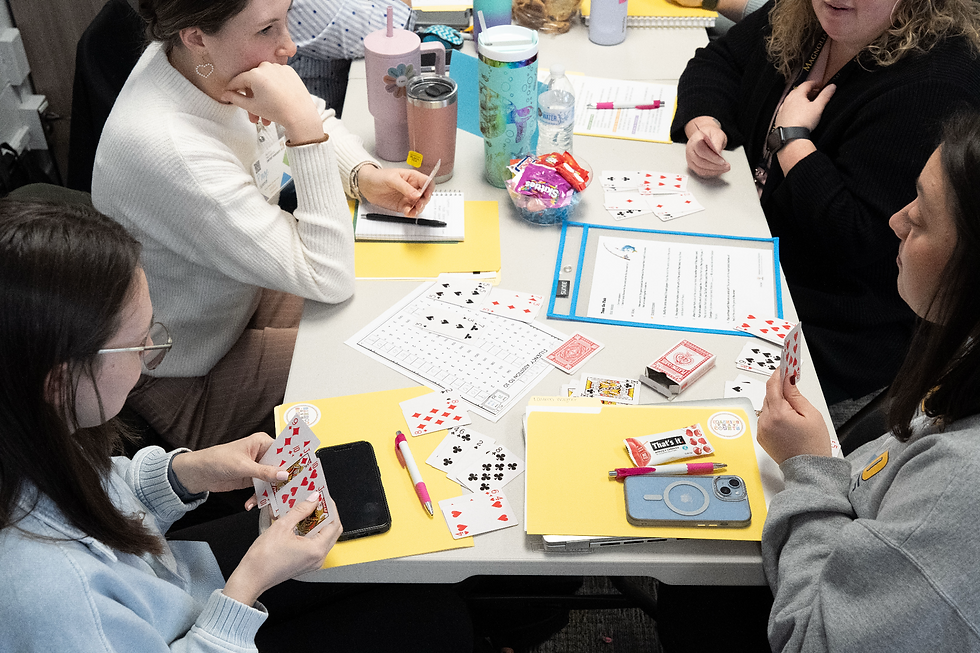
If you enjoyed the games and strategies shared throughout the Beyond the Algorithm series so far, much of this work is also explored in my caregiver workshop:
Count on a Good Time: Math Games & Tools You Can Use Tomorrow
This interactive workshop helps caregivers better understand how children develop math skills through strategies, play, and problem-solving—not just memorization.
Through hands-on experiences, caregivers explore simple games and routines that build:
accuracy
flexibility
confidence
and meaningful number sense

Participants also learn why today’s mathematics instruction may look different from how many adults learned math themselves and how to support children’s thinking during math at home.
Throughout the workshop, caregivers actively play games, explore fluency-building tools, and engage with activities designed to make math feel engaging, low-pressure, and approachable for families. Depending on the workshop format, participants may also receive ready-to-use games and activities to continue the learning at home.
Flexible workshop formats are available for schools, districts, and family math night events. If you are interested in bringing this experience to your school community, you can learn more at Coaching that Counts.



Comments