


Doubles Math Facts: From Ten Frames to Near Doubles

Updated: Jun 23
In a previous post, What Is Math Fluency ? More Than Memorizing Basic Math Facts, I discussed how fluency involves much more than quickly recalling addition and subtraction facts. As students develop mathematical fluency, they learn to use place value, properties of operations, and number relationships to solve problems efficiently. However, basic facts still play an important role in that development. Among the most important foundational relationships are doubles math facts, which help students build efficient strategies and develop a deeper understanding of how numbers are connected.
Unlike strategies such as Make a Ten or Take From Ten, doubles math facts are not typically considered derived fact strategies. Instead, they are foundational facts that students come to know and use as anchors for solving other addition problems. These facts eventually support the near doubles addition strategy, allowing students to use known relationships to reason about facts they may not yet know automatically.
One reason doubles math facts are so powerful is that students can see these relationships within visual models such as ten frames. Just as ten frames help students recognize numbers in relation to 5 and 10, they can also help students recognize equal pairs and develop an understanding of doubles relationships.
Common Doubles Math Facts
Doubles math facts are often among the first addition facts students learn because they follow a predictable pattern and are easy to recognize within visual models. The most common doubles math facts include:

Many students find doubles math facts easier to remember because they can connect them to familiar experiences and visual patterns. For example, students may think about two eyes (1 + 1), four legs on many animals (2 + 2), fingers on two hands (5 + 5), or eggs arranged in pairs within an egg carton (6 + 6). While these connections can help students remember facts, visual models such as ten frames help students understand the mathematical relationships behind them.
As students become fluent with doubles math facts, they can begin using them as anchors for solving related facts more efficiently. This understanding becomes especially important when students encounter strategies such as the near doubles addition strategy.
Seeing Doubles Math Facts on Ten Frames
Ten frames are commonly used to help students develop number sense and recognize quantities without counting by ones. Most often, students learn to view ten frames from left to right, allowing them to recognize numbers in relation to benchmark quantities of 5 and 10. This is sometimes referred to as five-wise recognition.
For example, when students see 8 on a ten frame, they may think of it as 5 and 3 more. When they see 9, they may think of it as 5 and 4 more or as 10 with 1 missing. These benchmark relationships support reasoning strategies like Make a Ten and Take From Ten because students learn to decompose and recompose numbers around 5 and 10.

However, benchmark relationships are not the only relationships students can see within a ten frame. Rather than focusing on the rows, students can also focus on the columns and begin seeing quantities as pairs. This perspective is often referred to as pair-wise recognition.
Rather than focusing on numbers in relation to 5 and 10, pair-wise recognition helps students see numbers as two equal quantities. Because each counter in the top row is paired with a corresponding counter in the bottom row, doubles math facts become visible within the structure of the ten frame. For example, students may recognize that 8 can be viewed not only as 5 and 3 more, but also as two equal groups of 4, making the doubles fact 4 + 4 = 8 visible. Similarly, 6 can be viewed not only as 5 and 1 more, but also as two equal groups of 3, making the doubles fact 3 + 3 = 6 visible.

These visual structures help students develop an understanding of doubles that extends beyond memorization. Students begin recognizing patterns and relationships that become useful when solving other addition problems.
To provide additional opportunities for students to explore these relationships, I have created a free set of Doubles Math Facts Cards featuring ten-frame representations of the doubles facts from 1 + 1 through 10 + 10. These cards can be used during number talks, centers, small-group instruction, intervention, or fluency routines to help students develop a deeper understanding of doubles relationships and the patterns they reveal.
Why Doubles Math Facts Matter
Doubles math facts occupy a unique place in the development of fact fluency. Unlike derived fact strategies, doubles facts become part of a student's growing network of known facts.
As students become increasingly comfortable with doubles math facts such as 4 + 4 = 8, 5 + 5 = 10, and 7 + 7 = 14, they begin using these facts to reason about related combinations. Rather than viewing every addition fact as a separate piece of information to memorize, students begin recognizing relationships among facts.
This shift from isolated facts to connected relationships is an important step in the development of computational fluency.
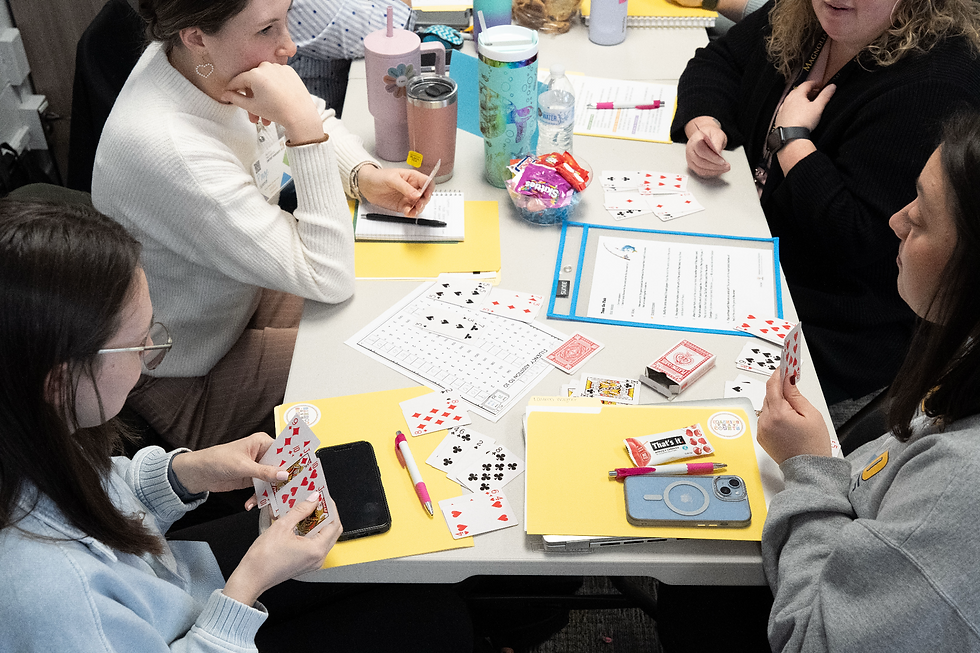
Students also need opportunities to discuss and apply these relationships in meaningful ways. Games can help reinforce doubles math facts while encouraging students to explain their thinking and make connections among facts. One game I particularly enjoy is Move It!, featured in the Kentucky Center for Mathematics' Resources for Virtual Mathematics Instruction collection.
To support this work, I have created free Move It! Game Boards and Directions that can be used alongside the Doubles Math Facts Cards shared earlier in this post. Together, these resources provide students with opportunities to practice doubles math facts through discussion, reasoning, and play.
You can find additional versions of Move It! and other instructional resources through the Kentucky Center for Mathematics' Resources for Virtual Mathematics Instruction collection.
From Doubles Math Facts to the Near Doubles Addition Strategy
One of the most common ways students use doubles math facts is through the near doubles addition strategy.
Double ten frames are a useful tool for exploring the near doubles addition strategy because they allow students to see the relationship between a known doubles fact and a related fact. Students can build each addend on a separate ten frame using two-color counters and compare the quantities visually.
For example, when modeling 7 + 8, students can see that the quantities are almost (or near) doubles. They may recognize that 7 + 8 is one more than 7 + 7 or one less than 8 + 8.

The near doubles addition strategy occurs when students use a known doubles fact to solve a related fact that is one more or one less.
For example:
5 + 6 can be thought of as 5 + 5 + 1.
7 + 8 can be thought of as 7 + 7 + 1 or even 8 + 8 - 1.
In each case, students begin with a doubles fact they know and then make a small adjustment.
Instead of viewing 7 + 8 as a completely new fact, students recognize its relationship to 7 + 7 or 8 + 8. This allows them to reason about the problem rather than relying solely on memorization.
Because doubles math facts are often among the earliest facts students learn, they become powerful anchors for deriving many other addition facts. Later, these same relationships can support students' understanding of multiplication as they begin working with equal groups and arrays in Grade 3. While doubles facts are fundamentally addition relationships, they help students develop the kind of relational thinking that supports future mathematical learning.
Building Fluency Through Number Relationships
Developing fluency is not about memorizing isolated facts. It is about helping students recognize patterns, structures, and relationships among numbers.
Ten frames support this work in multiple ways. Through five-wise recognition, students learn to see numbers in relation to 5 and 10. Through pair-wise recognition, students learn to see equal quantities and develop an understanding of doubles math facts. These foundational relationships then support more sophisticated reasoning strategies such as the near doubles addition strategy.
Over time, students build a connected network of number relationships that allows them to reason flexibly and compute efficiently. Doubles math facts are an important part of that network, helping students move beyond counting and toward deeper mathematical understanding.
This example also highlights an important idea: the manipulatives and models we choose matter. Different tools make different mathematical relationships visible. A ten frame can help students see benchmark relationships to 5 and 10 while also helping them recognize doubles relationships through pair-wise structures. The power of a manipulative is not simply that students can touch or move objects—it is that the structure of the tool helps reveal important mathematical ideas.
This idea is one of the reasons I am expanding my half-day workshop, Beyond Busywork: Meaningful Math Centers, into a new full-day learning experience for the 2026–2027 school year: Beyond Busywork: Designing Meaningful Math Experiences with Manipulatives and Centers. In this workshop, educators will explore how the design of tasks, centers, games, and manipulatives influences what students notice, discuss, and understand mathematically.
Both K–2 and 3–5 sessions will be offered, with dates, locations, and additional details announced soon. To stay informed about upcoming workshops, blog posts, and professional learning opportunities, subscribe to the Coaching That Counts newsletter or follow me on Facebook and Instagram for the latest updates.



Comments