


What is the Compensation Math Strategy? Here's How It Works
- Cheryl Fricchione
- Jul 15
- 7 min read

Updated: Aug 19
One of the goals of this series on computational fluency is to show that mental math strategies aren't isolated tricks to memorize—they're connected ways of thinking about numbers. In previous posts, we've explored strategies like Make a Ten, Take from 10, Down Under 10, and Subtracting by Adding Up, each of which helps students use number relationships to solve problems more efficiently. The compensation math strategy builds on those same ideas in a slightly different way. Rather than shifting quantities within the problem itself—as students do with strategies like Make a Ten, Take from 10, or Down Under 10—students intentionally create a different, easier problem to solve mentally. They then compensate for that change so the final answer is equivalent to the original expression. In this post, we'll explore what compensation in math is, how the compensation math strategy works, and why it helps students become more flexible, confident mathematicians.
What Is Compensation in Math?
So, what is compensation in math?
The compensation math strategy is a mental math strategy in which students temporarily adjust a number to create a friendlier computation. After solving the easier problem, they compensate by adjusting the answer to account for the change they made.
The strategy is called compensation because students compensate for the temporary change they made to the original problem. Rather than changing the mathematics, they simply create an easier computation and then adjust their answer so it matches the original expression.
For example, imagine a student solving:
198 + 47
Rather than adding 198 and 47 directly, the student notices that 198 is only 2 away from 200, a friendly benchmark number. They mentally solve the easier problem:
200 + 47 = 247
Because they added 2 to the first addend, they know their answer is 2 too large, so they compensate by subtracting 2.
247 − 2 = 245
The student didn't change the original problem. They simply created an easier one to solve mentally before compensating for the adjustment. That's the heart of the compensation math strategy.

Compensation for Subtraction
The compensation math strategy works just as well for subtraction.
Consider the problem:
503 − 198
Again, a student may notice that 198 is only 2 away from 200.
Instead of subtracting 198, they think:
503 − 200 = 303
Since they subtracted 2 more than the original problem required, they compensate by adding 2 back.
303 + 2 = 305
Again, the original expression never changed. The student simply solved a friendlier problem first.
A Different Way Students Might Reason
One of my favorite things about teaching the compensation math strategy is listening to students explain their thinking.
As students become more comfortable with subtraction, some naturally discover another mathematically valid approach.
Instead of compensating after solving the problem, they adjust both numbers by the same amount.
503 − 198
↓
505 − 200 = 305
If you've read my previous post on Subtracting by Adding Up, this idea may sound familiar. In that post, we touched on how students begin thinking about subtraction as finding the difference, or distance, between two numbers.
When students view subtraction this way, they realize that adding 2 to both numbers simply shifts both points two units to the right on the number line. Because both numbers move the same distance in the same direction, the distance between them stays exactly the same, so the difference remains 305.

Helping students compare these two approaches is incredibly powerful because they begin seeing that different strategies can be equally valid. The goal isn't for every student to think the same way. It's for every student to understand why their strategy works.
When Do Students Choose the Compensation Math Strategy?
Inspired by routines like Bridges in Mathematics' Think Before You Add, one of my favorite computational fluency activities is what I call a Strategy Battle. Students work with a partner, but each partner solves the same problem using a different strategy. Afterward, they compare not only their answers, but also which strategy felt most efficient—and why.
A few years ago, I facilitated this activity in a Grade 2 classroom. One of the problems was:
399 + 127
On this problem, one partner was asked to use the compensation math strategy, while the other was asked to use partial sums.
Without fail, every student who used compensation finished before their partner.
Not because compensation is always the fastest strategy.
Not because partial sums is a weaker strategy.
But because 399 naturally invited compensation.
Students quickly noticed that 399 was only one away from 400, a friendly benchmark number. They mentally solved 400 + 127 = 527 and then compensated by subtracting 1.
That discussion became much more valuable than simply deciding who finished first. Instead of asking, "What's the best strategy?" students began asking, "What do these numbers invite us to do?"
As the class continued to compare strategies over several days, the teacher and her students co-created an anchor chart that identified situations where different strategies made sense. Rather than memorizing a list of procedures, students were learning to analyze the numbers and make strategic decisions about which approach would be most efficient.

Student Thinking Matters
One of my favorite parts of teaching the compensation math strategy is listening to students explain their thinking.
Everyone thinks differently.
That's something we should celebrate.
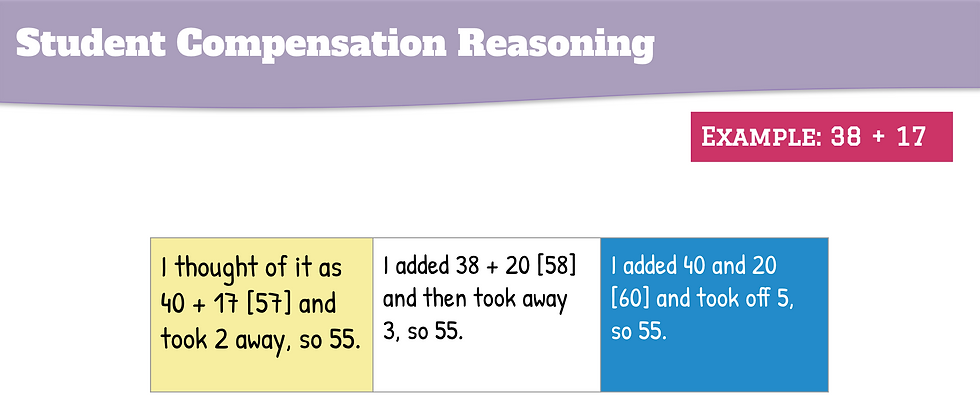
Different students naturally notice different relationships in the same problem. Some students change one number to create a friendlier computation and then compensate by adjusting their answer. Others adjust both numbers to create an equivalent expression that is easier to solve. Still others may decide that compensation isn't the most efficient strategy for that particular problem—and that's okay, too.
Our goal isn't to get every student to imagine the numbers the same way.
Our goal is to help every student build a repertoire of strategies they understand well enough to choose from.
When students explain and compare their reasoning, everyone learns.
Visual Models That Support the Compensation Math Strategy
Like every strategy in this series, the compensation math strategy develops best when students move from concrete models to visual representations and, eventually, mental reasoning.
Counters help students understand that the quantity doesn't change simply because we think about it differently. Students can physically move counters to create friendlier benchmark numbers before transitioning to mental compensation. Seeing that no counters are added or removed helps students understand that the quantity hasn't changed—only the way they're thinking about it. This concrete experience helps them understand why the compensation math strategy works instead of memorizing a series of steps. Two-color counters or other classroom counters work well for helping students model these relationships.
A number line is especially powerful for subtraction. As students begin viewing subtraction as finding the distance between two numbers, they can visualize that shifting both numbers the same amount preserves the distance. This builds directly on the ideas we explored in Subtracting by Adding Up and reinforces that the compensation math strategy is grounded in mathematical reasoning—not a shortcut.
If you're modeling this idea for students, the free Number Line app from The Math Learning Center (the same organization that publishes Bridges in Mathematics) is an excellent tool. It allows you to drag a jump to a new location on the number line while preserving its length. This makes it easy to demonstrate that when both numbers are adjusted by the same amount, the difference stays the same.
Looking Ahead
One of the things I appreciate most about the compensation math strategy is that students don't outgrow it. As they begin working with decimals and fractions, the same reasoning continues to support efficient computation.
For example, students may recognize that 1.98 is close to 2.00 or that 2 7/8 is close to 3, temporarily create a friendlier computation, and then compensate for the adjustment.
Note: Online content management tools don't always handle math notation well. If a fraction shows up with a slash, just remember that in the classroom, we want to format them as shown in the graphic below, since that helps students really see the numerator and denominator.

While the numbers become more sophisticated, the mathematics stays the same. Students continue looking for benchmark numbers, creating equivalent computations, and compensating for temporary adjustments. That's why it's so important to help students develop flexible reasoning rather than simply teaching procedures. The compensation math strategy is a way of thinking that students can continue refining as they encounter increasingly complex mathematics.
Final Thoughts
Throughout this series on computational fluency, we've explored strategies that help students make sense of numbers by noticing relationships and choosing efficient approaches. The compensation math strategy adds another powerful tool to that repertoire.
Perhaps the most important takeaway isn't learning another strategy. It's helping students recognize that numbers offer choices. Different students notice different relationships, and different problems invite different strategies.
That's the kind of mathematical thinking we want to cultivate.
Computational fluency isn't about getting every student to think the same way. It's about helping students build a repertoire of strategies, explain their reasoning, and choose approaches that make sense for the numbers in front of them. When we create classrooms where students share, compare, and justify their thinking, they develop much more than efficient computation—they develop confidence, flexibility, and a deeper understanding of mathematics.
Bring These Conversations to Your School
If this post resonated with you, imagine these kinds of mathematical conversations happening every day in your classrooms. During my professional learning workshops, teachers experience computational fluency as learners, analyze authentic student thinking, and explore practical routines that help students develop flexibility, confidence, and lasting number sense.
Whether we're exploring the compensation math strategy, comparing mental math strategies, or discussing how visual models support student understanding, the focus is always the same: creating classrooms where student thinking drives instruction.
My 2026–2027 professional learning calendar is already beginning to fill. If you're interested in bringing these kinds of mathematical conversations to your school or district, I'd love to connect. Together, we can create classrooms where students don't focus solely on getting the right answer, but on making sense of numbers, comparing strategies, and justifying their reasoning. Those are the kinds of mathematical conversations that last long after students leave our classrooms.


Comments